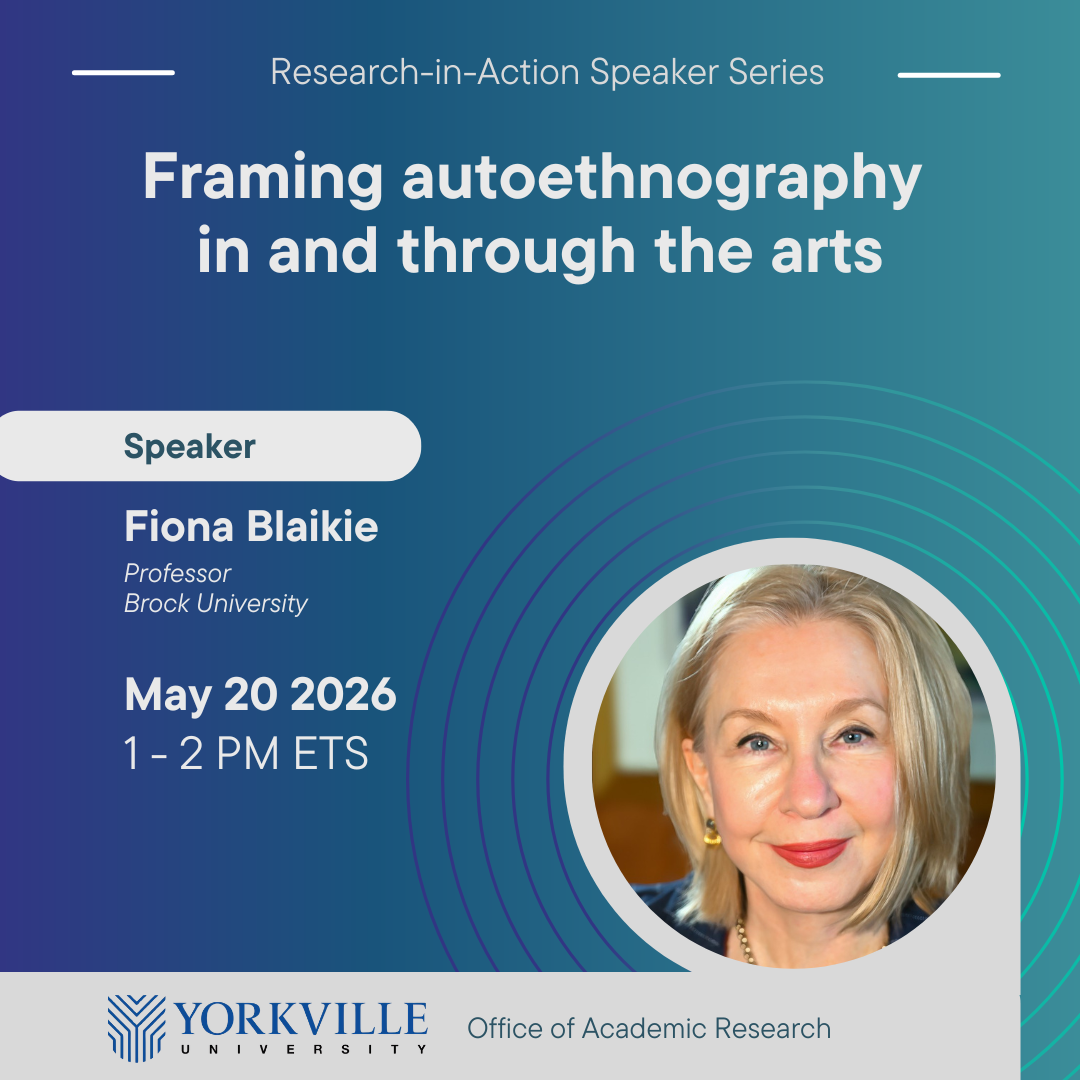
On May 20, 2026, the Office of Academic Research (OAR) hosted another engaging session in its Research in Action speaker series. Faculty gathered online to hear Dr. Fiona Blaikie, Professor at Brock University and former Dean and Chair of AERI, deliver a rich and wide-ranging talk on autoethnography and arts-based approaches to research. The session drew enthusiastic participation from colleagues across campuses and sparked a lively discussion on qualitative methods, emerging methodologies, and practical research design.
About the Speaker
Dr. Fiona Blaikie brings decades of expertise in arts education, qualitative inquiry, and curriculum studies. In addition to her academic and administrative roles at Brock University, she serves as Associate Director of the Posthumanism Research Institute and as Chief Examiner of IBO Visual Arts. Her scholarship explores aesthetic and pedagogical values in studio arts assessment and the epistemological bridges connecting secondary and post-secondary arts education.
A Journey Through Research Paradigms
Dr. Blaikie opened with a sweeping overview of how research methods have evolved over the past century—from the authority-centred, deductive logic of quantitative paradigms to the interpretive and narrative turn of qualitative research in the 1980s and 1990s. She traced key milestones, including Elliott Eisner’s 1993 presidential address at AERA, the emergence of arts-based educational research (ABER) co-developed by Eisner and Tom Barone at Stanford, and Rishma Dunleavy’s 1999 novel-as-dissertation at York University—a historic moment in Canadian qualitative scholarship.
From there, Dr. Blaikie introduced participants to a constellation of methodological frameworks: phenomenology (the study of lived experience), artography (reflective arts-based inquiry with students and teachers), arts-informed research (AIR), post-qualitative inquiry, new materialism, and worlding. Each approach, she explained, represents a different relationship between the researcher, participants, and the materials and contexts of knowledge production.
Arriving at Autoethnography
The session culminated in an exploration of autoethnography—research in which the scholar writes about their own cultural experience (auto = self, ethno = culture, graphy = to write). Dr. Blaikie drew on her own practice, combining phenomenological knowing, visual identity, and art-led methods to examine what counts as art, pedagogy, and scholarship. She also pointed participants to published autoethnographic dissertations as accessible models for the method in practice.
We thank Dr. Fiona Blaikie warmly for her generosity, depth of knowledge, and infectious passion for research methodology. And we thank everyone who joined us for making it such a rich conversation.