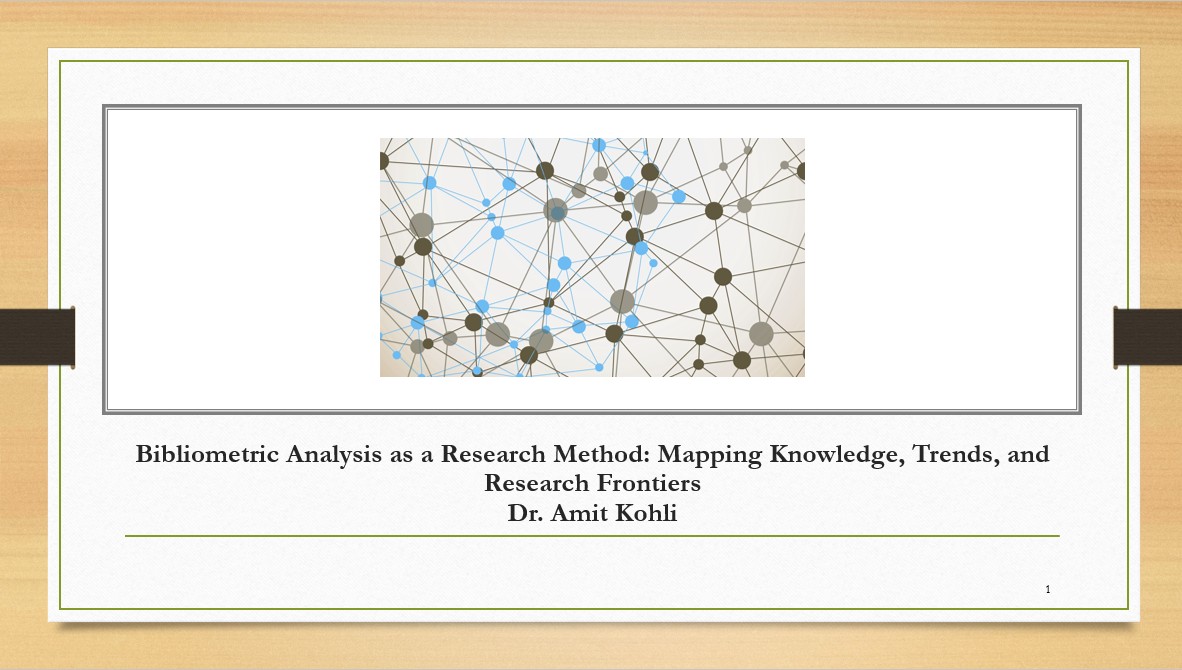
On February 17, 2026, the Office of Academic Research (OAR) hosted a 90‑minute interactive workshop on bibliometric analysis, bringing together faculty and staff interested in strengthening their research planning and literature review strategies.
The session was facilitated by Dr. Amit Kohli, sectional faculty member with over 20 years of academic and industry experience, and welcomed participants from a range of research backgrounds—many of whom were new to bibliometric methods. The workshop was moderated by Thu Le, Director of Academic Research, who opened the session by situating bibliometric analysis as a practical methodology for identifying research trends, key authors, journals, and collaboration networks.
From Concept to Practice: Understanding Bibliometric Analysis
Dr. Kohli began by introducing bibliometric analysis as a statistical approach to analysing published research, contrasting it with systematic literature reviews (SLRs). While SLRs focus on in‑depth content synthesis, bibliometric analysis emphasizes patterns, trends, and research structures—such as publication growth, citation impact, dominant journals, and leading countries.
Participants learned how bibliometric analysis can:
- Identify influential authors, journals, and institutions
- Reveal emerging and declining research themes
- Map international and institutional research collaborations
- Support strategic decision‑making for research focus and publication planning
Demonstration Using R and Biblioshiny
A key highlight of the workshop was a live, step‑by‑step demonstration using the open‑source Bibliometrix R package and its user‑friendly web interface, Biblioshiny. Dr. Kohli walked participants through the full workflow—from exporting records from databases such as Scopus or Web of Science, to importing and analysing bibliographic data within the software.
Using a sample dataset of academic articles, the demonstration showed how users can generate visualizations and tables illustrating:
- Annual publication and citation trends
- Core journals and Bradford’s Law
- Most productive authors and institutions
- Keyword frequency and thematic evolution
- Country‑level research output and collaboration patterns
Connecting Bibliometrics to Research Strategy
Throughout the session, participants engaged in a lively discussion about how bibliometric analysis can inform research planning, grant development, and publication strategy. Questions explored the use of keywords, differences across academic databases, multilingual literature, and how bibliometric findings can guide subsequent systematic reviews.
Dr. Kohli emphasized that bibliometric analysis is most powerful when combined with qualitative review methods, helping researchers move from a broad overview of the field to deeper thematic analysis and theory building.
Building Research Capacity at Yorkville
The workshop concluded with reflections on how bibliometric tools can support a growing research culture by making literature reviews more efficient, transparent, and strategic. The workshop recording, slides, and sample resources can be found here: Bibliometric Analysis, Dr. Amit Kohli, 20260217 | Office of Academic Research | Yorkville University
Thanks Dr. Amit Kohli and all attendees for contributing to a thoughtful and engaging discussion and looks forward to hosting future professional development sessions focused on advanced research methods and scholarly publishing.